
Small business website package
Website design built to rank.
A website that looks good and ranks for nothing is a brochure nobody asked for. Vertana builds the done-for-you small business website the other way around: a package engineered page by page for the SEO that gets you found, and built like a front desk that books the client, signs the agreement, and takes the payment.
Talk to JonMost websites are designed. Yours should be engineered.
Most small business sites are built to look right in a portfolio. The pictures are nice, the copy is vague, every service is crammed onto one page, and the whole thing is invisible to search. Then the owner pays someone else, later, to bolt SEO onto it.
We think that is backwards. The decisions that determine whether you rank are structural: what the pages are, how they are named, how they link, what the headings say, how fast it loads, whether a machine can read it. Those are build decisions. Make them right and the SEO has something to stand on. Make them wrong and you pay twice.
So the build is the foundation, not the product. The point of the site is to get found and to get you booked.
What you get in the build.
Built on a structure search engines can read
Clean markup, one clear topic per page, headings in order, fast loads, and structured data. Not a page builder that ships a wall of unreadable divs.
A page for each thing you actually sell
One service, one page, written for how people search for that service. This is what lets you rank for more than your own business name.
Written for your town, not a template
Real copy about the work you do and the area you serve, so the local searches and the map pack have something to match.
A front desk on every page
Book an appointment, start an intake, sign the agreement, pay the invoice. On your domain, wired into the tools you already run.
Facts an assistant can quote
Services, service area, hours, and proof stated plainly and marked up, so ChatGPT and other assistants can pick you up and recommend you correctly.
Yours, and editable
You own the domain, the content, and the analytics. Nothing is locked behind a platform you cannot leave.
What’s in the package, and what it costs.
This is not a website builder. You do not pick a template, fight the theme, and hope Google can read it. Vertana designs and builds the site as a done-for-you package: the pages, the copy, the markup, and the booking, intake, signature, and payment on your domain.
Builds are quoted after a call. Our monthly plans are public and start at $500 a month with JB. For the build itself, the market ranges we see in 2026, not a survey: professional small-business sites commonly sit at $2,000–$8,000 from a freelancer or small shop, less for a template you assemble yourself, more from a boutique. The number moves with how many services you sell and what already exists. The cost guide has the job-by-job breakdown.
The site is where it starts. The monthly SEO is the work that compounds. A site that only looks finished and cannot book is a brochure. The front-desk version is the same build, doing the job of a receptionist without answering the phone.
The build decides most of this before a word is written.
Speed, structure, and readability are not polish applied at the end. Google states plainly that Core Web Vitals are used by its ranking systems, and just as plainly that good scores guarantee nothing on their own. They are the floor, and most of the web is still under it.
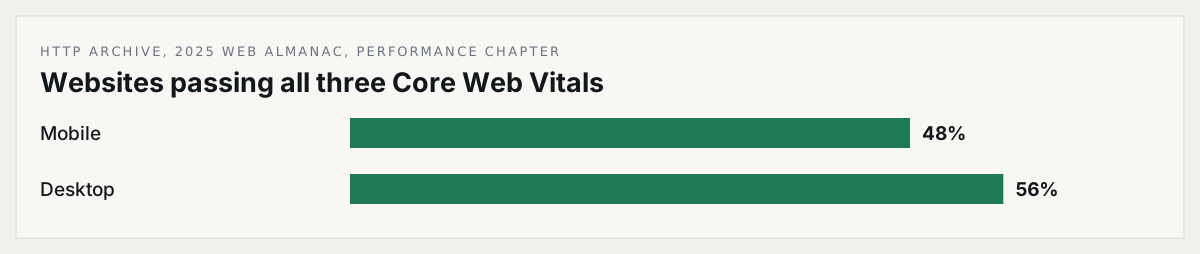
- 48%
- of mobile websites pass all three Core Web Vitals. Desktop is 56%. More than half the web still fails Google's own loading, responsiveness and stability bar on phones.
- HTTP Archive, Jan 2026
- 2.5s
- is Google's threshold for Largest Contentful Paint, the loading measure it treats as good. Only 62% of mobile sites clear it.
- web.dev; HTTP Archive, Jan 2026
- 49%
- of US adults now use AI chatbots, up from 33% two years earlier, and four in ten use them to search for information. They can only quote a site they can read.
- Pew Research Center, Jun 2026
Almost everyone who finds you is holding a phone.
This is the part that decides whether the speed numbers above matter to you specifically. In July 2026, seven in ten organic clicks to Conduit Law, the firm Jon founded and runs marketing for, came from a phone. Desktop was under a third. Tablet was a rounding error.
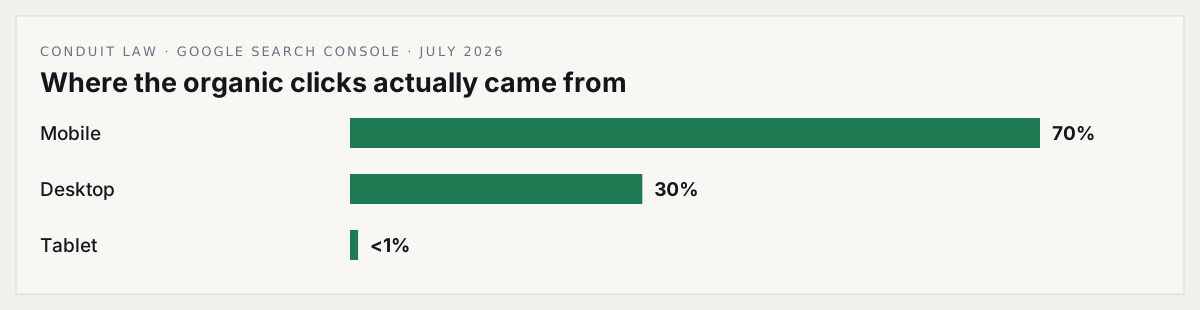
So a site that is approved on a designer’s desktop monitor and merely tolerable on a phone has been optimised for the wrong third of its audience. We build and test the phone version first, and the desktop one inherits from it.
What “built to rank” means, concretely.
It is a vague phrase in most hands, so here is the specific list. These are decisions made during the build that are expensive to reverse later.
- One page per thing you sell
- A page can rank for the topic it is about. Five services crammed onto one page gives Google one weak answer instead of five specific ones, and gives an assistant nothing precise to quote.
- Headings that describe, in order
- One H1 that says what the page is, H2s that name the real sections. This is how both a screen reader and a language model work out what the page covers.
- Speed treated as a requirement
- Images sized and compressed, fonts loaded sanely, no stack of third-party scripts. Google's threshold for good loading is 2.5 seconds to the largest element, and the 2025 Web Almanac found only 62% of mobile sites clear it. The failures are usually marketing widgets and tracking, not the site itself.
- Content in the HTML
- Text that exists in the page as delivered, not assembled by JavaScript afterwards. Crawlers and AI assistants are far more reliable with the former.
- Structured data that matches reality
- Your services, area, hours, and reviews marked up so machines read the same facts a person does. This is a large part of how you become quotable.
- Internal links with intent
- Pages that support each other, so authority reaches the pages that sell rather than pooling on the homepage.
- Analytics and Search Console from day one
- In your accounts, in your name. You should be able to see what the site is doing without asking us.
A site that books is worth more than a site that ranks.
Ranking gets someone to the page. What happens next decides whether you got a client or a visitor. Most small business sites end at a contact form that goes to an inbox nobody watches on a job site.
Every site we build works like a front desk instead. The visitor books a time, starts an intake, signs, or pays, right there, without waiting for you to call back. Andersen’s calendar filled in four weeks after we took over his site and his Google Business Profile.
We do not answer your phone and we are not a receptionist service. We build the site so that fewer of those calls need answering at all. How the front-desk website works.
Then the SEO keeps going.
Launch day is the starting line. Rankings arrive over months, and they arrive for the businesses that keep publishing and keep tightening. That work is monthly, and it is the reason the site pays for itself.
Go deeper.
What it costs, what to include, builders versus done-for-you, whether you need one if referrals already cover you, and the front-desk version of the same build.
- JB, the AI agent for small business
Keeps you found on Google and ChatGPT, sorts new leads, and drafts your emails, all by text. From $500 a month.
- How much a small business website costs
Market ranges, priced by the job the site has to do rather than by page count.
- What a small business website should include
The 2026 checklist: pages that can rank, a front desk that finishes the job, and facts an assistant can quote.
- Website builders vs done-for-you, honestly
When a builder is enough, when it is the wrong product, and why we will not rank the brands.
- Do you need a website if referrals already cover you?
When you can wait, when a Google Business Profile is enough, and when the referrals are already bouncing.
- A website that books, signs, and takes payment
What the front-desk install actually does, and why it is not an answering service.
- Client onboarding: first click to getting paid
The path from the first visit to a signed, paid job, on your domain rather than in a portal.
- Law and wellness, named
The two trades we can show: Conduit on the law side, Andersen Sports Massage on the wellness side.
Common questions.
- What is SEO website design?
- It means the site is built for search from the start instead of optimized afterward. Page structure, URLs, headings, internal links, load speed, and copy are all decided based on what people search for. Retrofitting those choices onto a finished site is slower and more expensive than making them correctly the first time.
- How much does a small business website cost?
- The market ranges we see in 2026, not a survey and not a Vertana quote: roughly $500-$2,000 for a template site you assemble yourself, $2,000-$8,000 for a professional build from a freelancer or small agency, and $8,000-$15,000 or more from a boutique agency. Vertana prices each build on a call, because most of the cost depends on how many services you sell and what already exists. The job-by-job breakdown is in the cost guide.
- Do I need a website if I get all my work from referrals?
- Referrals still check you online before they call, and the ones who cannot find anything credible quietly go elsewhere. A site also captures the searches happening in your area right now that never reach you. If referrals are strong, the site's job is to convert them faster and add a second channel next to them. When you can wait is its own guide.
- Can you work with my existing website?
- Often, yes. If it is fast, crawlable, and editable, optimizing what you have is cheaper than replacing it. If it is a locked template or nobody can update it, rebuilding usually costs less than fighting it. We tell you which one you are in before you spend anything.
- How long does the build take?
- A typical owner-operator site goes live in two to four weeks once we have your content and access. The SEO work continues monthly after that, because ranking is not something a launch finishes.
Full versions: website cost · do you need a website.
Sources
- HTTP Archive, 2025 Web Almanac, Performance chapter (Jan 2026). Chrome UX Report data from July 2025 across the public web. Source for the Core Web Vitals pass rates.
- Google Search Central, Understanding page experience (Dec 2025). Google's statement that Core Web Vitals are used by its ranking systems, and that good scores are not a ranking guarantee.
- web.dev, Largest Contentful Paint. Google's documentation of the Core Web Vitals loading threshold.
- Pew Research Center, Americans and AI 2026 (Jun 2026). American Trends Panel survey of 5,119 US adults, fielded February 17-23, 2026.
Let’s look at what you have.
Book a call and Jon will tell you straight whether your current site can be fixed or should be rebuilt, and what it would take either way.
Talk to JonBook a call. No pitch, just a look at your business.