
85 Small Business SEO Statistics
Every number here was read off the page of whoever produced it. Government statistics, academic research, industry-neutral infrastructure data, and the platforms' own disclosures. No SEO-vendor surveys and no roundups, because we sell SEO and will not hand you someone else's marketing as evidence.
Updated October 2026 · Vertana
Most SEO statistics pages are assembled from other SEO statistics pages, and most of the underlying numbers were produced by companies selling SEO. We sell SEO too, which is exactly why we did not do that. Every figure below came off the page of whoever produced it: federal courts, the Census Bureau, the Bureau of Labor Statistics, Pew Research Center, the HTTP Archive's crawl of the web, and the platforms' own disclosures about themselves.
Where a number is contested, we say so. Where the only source was a vendor, we left the claim out rather than borrow their marketing.
Key Takeaways
- A federal court found Google held 89.2% of US general search by query volume as of 2020, and 94.9% on mobile.
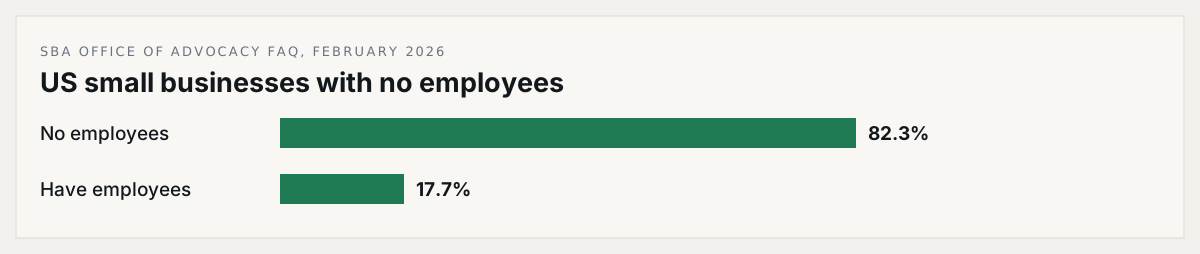
- 82.3% of US small businesses have no employees. Of those, 86.7% are sole proprietorships.
- Title tags appear on 98.6% of desktop pages. Meta descriptions appear on 67.7%. About one page in three has none.
- HTTPS is on 91.7% of desktop pages. The crawl only covers the already-visible web.
- 48% of mobile sites pass all three Core Web Vitals.
- 68.01% of US Google searches ended without a click in January through April 2026.
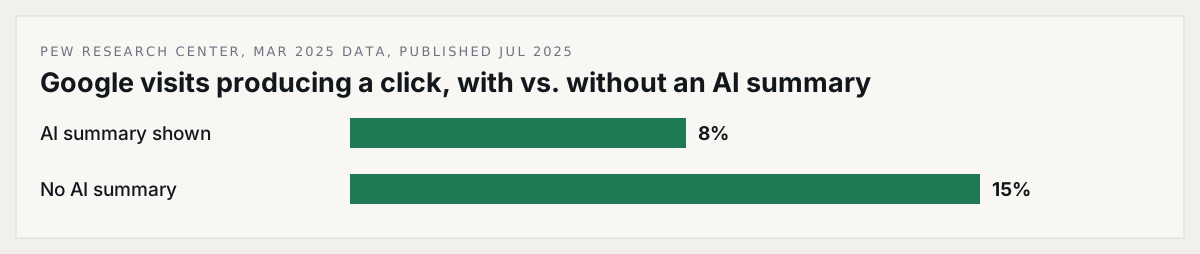
- With an AI summary on the page, users clicked a traditional result on 8% of visits, against 15% without one. They clicked a source inside the summary on 1%.
- 49% of US adults have used an AI chatbot, up from 33% two years earlier. 42% of all US adults use one to search for information.
- 60% of queries beginning with who, what, when, or why produced an AI summary.
- Only 7.6% of US businesses used AI between September 2024 and August 2025.
- 77.9% of establishments that opened in the year to March 2024 survived their first year.
- Google states AI Overviews has over 2.5 billion monthly active users and AI Mode has surpassed one billion, without defining either figure.
How much of search is still Google
The strongest evidence here is not a marketing study. It is the record of *United States v. Google LLC*, where a federal judge made findings of fact after a ten-week trial, on figures the opinion notes Google did not contest.
- A federal court found Google held 89.2% of the US general search market by query volume as of 2020.[1]United States v. Google LLC, Memorandum Opinion (Findings of Fact), No. 1:20-cv-03010-APM, D.D.C., August 5 2024
- The same finding put Google's share at 94.9% on mobile devices.[1]United States v. Google LLC, Memorandum Opinion (Findings of Fact), No. 1:20-cv-03010-APM, D.D.C., August 5 2024
- On desktop, the court put Google's share at 84% — notably closer to independent panel measurements than the headline figure.[1]United States v. Google LLC, Memorandum Opinion (Findings of Fact), No. 1:20-cv-03010-APM, D.D.C., August 5 2024
- Google's share rose from 80% in 2009 to 89.2% by 2020, so its position strengthened over the decade rather than eroding.[1]United States v. Google LLC, Memorandum Opinion (Findings of Fact), No. 1:20-cv-03010-APM, D.D.C., August 5 2024
- Bing, the second-place general search engine, takes roughly 6% of queries. Yahoo and DuckDuckGo are each under 3%, and both syndicate Bing's results rather than running independent indexes.[1]United States v. Google LLC, Memorandum Opinion (Findings of Fact), No. 1:20-cv-03010-APM, D.D.C., August 5 2024
- The court concluded that "Google is a monopolist, and it has acted as one to maintain its monopoly," in violation of Section 2 of the Sherman Act.[1]United States v. Google LLC, Memorandum Opinion (Findings of Fact), No. 1:20-cv-03010-APM, D.D.C., August 5 2024
- In its 2025 remedies opinion the court wrote that "still today, 'Google has no true competitor.'"[2]United States v. Google LLC, Remedies Memorandum Opinion, No. 1:20-cv-03010-APM, D.D.C., September 2 2025
- Contrary to the common assumption that AI answers cannibalize search, the court found AI Overviews increased US Google queries by 1.5 to 2%.[2]United States v. Google LLC, Remedies Memorandum Opinion, No. 1:20-cv-03010-APM, D.D.C., September 2 2025
- Independent panel data put Google at 73.7% of desktop searches across 41 major search-active sites in Q4 2025 — a narrower measurement than the court's, and desktop only.[3]SparkToro and Datos, Search Happens Everywhere, March 2026
- Across those same sites, traditional search engines took about 80% of all searching, commerce sites about 10%, social networks about 5.5%, and AI tools 3.2%.[3]SparkToro and Datos, Search Happens Everywhere, March 2026
- Amazon, Bing and YouTube each still receive more desktop search activity than ChatGPT.[3]SparkToro and Datos, Search Happens Everywhere, March 2026
What this means if you run a small business. Search did not move somewhere else. It consolidated. The practical implication is boring and unwelcome: there is no clever channel that lets you skip being findable on Google.
Who is actually available to do the work
This is the part the SEO industry rarely publishes, because the honest numbers undercut the premise that every small business can hire help.
- There are 36,207,130 small businesses in the United States.[4]SBA Office of Advocacy, Frequently Asked Questions About Small Business, February 2026
- 82.3% of them — 29,811,495 firms — have no employees at all.[4]SBA Office of Advocacy, Frequently Asked Questions About Small Business, February 2026
- 86.7% of those nonemployer businesses are sole proprietorships: one person, no staff, no marketing department.[4]SBA Office of Advocacy, Frequently Asked Questions About Small Business, February 2026
- Among businesses that *do* have employees, 63% have fewer than five, averaging about 1.6 employees each.[5]US Census Bureau, Statistics of U.S. Businesses, 2022 annual data
- Small businesses are 99.9% of all US firms but only 45.9% of private-sector employment and 43.5% of GDP. "Small" in that statistic means under 500 employees, which is a far larger business than most readers picture.[4]SBA Office of Advocacy, Frequently Asked Questions About Small Business, February 2026
- The Census Bureau counted 30.4 million nonemployer businesses generating $1.8 trillion in receipts in 2023 — roughly $59,000 each per year.[6]US Census Bureau, Business Owner Characteristics release, November 2025
- Americans filed 531,728 business applications in August 2026 alone.[7]US Census Bureau, Business Formation Statistics, September 2026 release
- Of that month's applications, the Census Bureau projects only 28,501 will become businesses with payroll within four quarters. That projection counts only the payroll path, not the nonemployer path most small businesses actually take.[7]US Census Bureau, Business Formation Statistics, September 2026 release
- 5,671,836 business applications were filed in calendar year 2025.[8]US Census Bureau, Business Formation Statistics monthly time series
- 77.9% of establishments that opened in the year to March 2024 survived their first year — about one in five did not.[9]US Bureau of Labor Statistics, Business Employment Dynamics, survival of private sector establishments
- Following a full cohort out: of establishments opening in the year to March 2015, 79.6% survived one year, 50.2% survived five years, and 34.7% survived ten.[9]US Bureau of Labor Statistics, Business Employment Dynamics, survival of private sector establishments
- Surviving first-year establishments averaged 4.4 employees. These are small operations even when they work.[9]US Bureau of Labor Statistics, Business Employment Dynamics, survival of private sector establishments
- 338,000 new establishments were born in the fourth quarter of 2025, accounting for 1,006,000 jobs.[10]US Bureau of Labor Statistics, Business Employment Dynamics news release, fourth quarter 2025
- Firms with 1 to 49 employees added a net 194,000 jobs in that quarter, more than firms with 50–249 (138,000) or 250 or more (126,000).[10]US Bureau of Labor Statistics, Business Employment Dynamics news release, fourth quarter 2025
- 9.5 million Americans were unincorporated self-employed workers in August 2026, plus 6.9 million incorporated. This counts self-employment as a main job, which is why it reads far below the nonemployer firm count.[11]US Bureau of Labor Statistics, Employment Situation, Table A-9, August 2026
- 1.3 million business establishments opened in 2023 and about 1.2 million closed.[4]SBA Office of Advocacy, Frequently Asked Questions About Small Business, February 2026
- 4.3 million small-business establishments operate in rural areas, 96.5% of all establishments outside metropolitan areas, accounting for 56.6% of rural employment.[4]SBA Office of Advocacy, Frequently Asked Questions About Small Business, February 2026
- Only 7.6% of US businesses used AI between September 2024 and August 2025. Businesses with fewer than five employees came second at 8.2%, ahead of mid-size firms and behind only the 250-plus class at 11.4%.[4]SBA Office of Advocacy, Frequently Asked Questions About Small Business, February 2026
What this means if you run a small business. No neutral organisation publishes a reliable figure for who does the marketing inside a very small firm, so we are not going to invent one. But 1.6 employees per small employer firm, and 86.7% of nonemployers being sole proprietorships, makes the answer structurally obvious: you do. That is the real constraint, and any plan that ignores it fails.
A site that exists is not a site that gets found
These figures come from the HTTP Archive's annual crawl, which is industry-neutral infrastructure data rather than a vendor survey. One caveat matters and we state it up front: the crawl draws its URL list from the Chrome UX Report, which only includes pages that clear an undisclosed popularity threshold.[12]Chrome UX Report methodology, Google Chrome developer documentation So every number below describes the already-visible web. The genuinely invisible sites are not in the sample at all, which makes these figures a floor rather than an average.
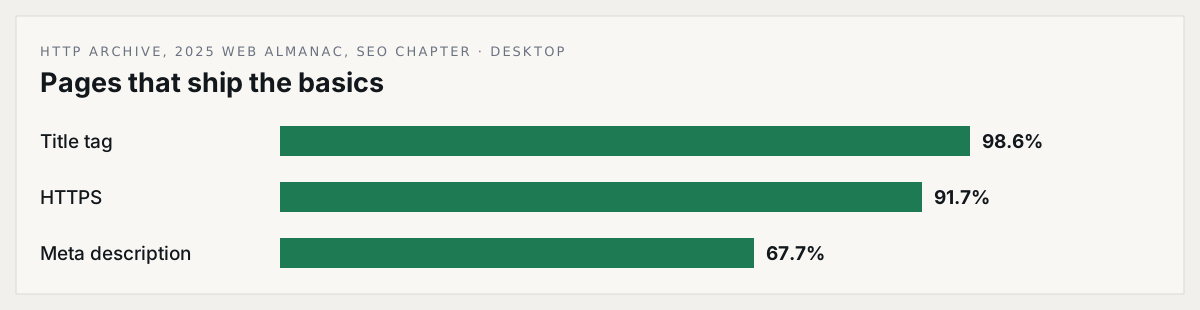
- Title tags appear on 98.6% of desktop pages and 98.5% of mobile pages. Nearly everyone has one.[13]HTTP Archive, Web Almanac 2025, SEO chapter
- Meta descriptions appear on only 67.7% of desktop pages and 67.2% of mobile. About one page in three has none.[13]HTTP Archive, Web Almanac 2025, SEO chapter
- The median title tag runs 77 characters on desktop and 79 on mobile — roughly 1.3 times the length Google will typically display.[13]HTTP Archive, Web Almanac 2025, SEO chapter
- The median meta description runs 274 characters, about 1.7 times the length that typically survives to the search result.[13]HTTP Archive, Web Almanac 2025, SEO chapter
- H1 headings appear on 71% of desktop pages, but only 66% are non-empty — a meaningful share ship an H1 containing nothing.[13]HTTP Archive, Web Almanac 2025, SEO chapter
- Only 50% of home pages carry any structured data, the markup that tells search engines and assistants what a page is about. JSON-LD accounts for 43%.[13]HTTP Archive, Web Almanac 2025, SEO chapter
- Just 2% of pages add structured data via JavaScript, so most sites that have it deliver it in the initial HTML.[13]HTTP Archive, Web Almanac 2025, SEO chapter
- 13% of requests for robots.txt return a 404.[13]HTTP Archive, Web Almanac 2025, SEO chapter
- Canonical tags appear on 68% of desktop pages, leaving about a third with no explicit signal about duplicate URLs.[13]HTTP Archive, Web Almanac 2025, SEO chapter
- HTTPS is used by 91.7% of desktop pages and 91.5% of mobile.[13]HTTP Archive, Web Almanac 2025, SEO chapter
- The viewport meta tag appears on 93.1% of desktop pages and 95.2% of mobile, so the basic mobile declaration is close to universal.[13]HTTP Archive, Web Almanac 2025, SEO chapter
- At the median, only 60% of a page's images carry alt attributes.[13]HTTP Archive, Web Almanac 2025, SEO chapter
- About 50% of images have either an empty alt attribute or alt text shorter than ten characters.[14]HTTP Archive, Web Almanac 2025, Accessibility chapter
- Only around 30% of sites meet minimum colour-contrast requirements.[14]HTTP Archive, Web Almanac 2025, Accessibility chapter
- 48% of mobile sites achieve good Core Web Vitals, against 56% on desktop — up from 44% and 55% a year earlier.[15]HTTP Archive, Web Almanac 2025, Performance chapter
- 62% of mobile pages achieve a good Largest Contentful Paint, against 74% on desktop, and mobile shows nearly double the rate of poor experiences (13% versus 7%).[15]HTTP Archive, Web Almanac 2025, Performance chapter
- Only 15% of mobile pages pass Lighthouse's render-blocking resources audit.[15]HTTP Archive, Web Almanac 2025, Performance chapter
- 62% of mobile pages fail to set explicit dimensions on at least one image, the most common cause of layout shifting as a page loads.[15]HTTP Archive, Web Almanac 2025, Performance chapter
- 44% of mobile sites have a good Time to First Byte; 17% are poor.[15]HTTP Archive, Web Almanac 2025, Performance chapter
- 77% of mobile sites achieve good Interaction to Next Paint, but secondary pages perform far worse than home pages — 69% on mobile against 95% on desktop.[15]HTTP Archive, Web Almanac 2025, Performance chapter
- CMS-driven sites are more than 54% of the observed web, and WordPress powers roughly 64% of those.[16]HTTP Archive, Web Almanac 2025, CMS chapter
- Platform choice tracks with performance: WordPress mobile sites reached 53% good LCP, against Duda at 94% and Wix at 81%.[16]HTTP Archive, Web Almanac 2025, CMS chapter
- Google states plainly that "indexing isn't guaranteed; not every page that Google processes will be indexed."[17]Google Search Central, In-depth guide to how Google Search works
- Google also notes that search snippets "are primarily created from the page content itself," and that your meta description is used only when it would describe the page better.[18]Google Search Central, Control your snippets in search results
- Google may rewrite your title link entirely: "If we've detected an issue on the page, we may try to generate an improved title link from anchors, on-page text, or other sources."[19]Google Search Central, Influencing your title links in search results
What this means if you run a small business. The median page on the measurable web ships a title a third too long and a meta description nearly twice too long. Those are not exotic technical failures. They are the two fields a person can fix in an afternoon, and most sites have not.
Ranking is no longer the same thing as getting a visit
- 68.01% of US Google searches ended without a click in the first four months of 2026.[20]SparkToro and Similarweb, In 2026, less than one third of Google searches still send a click, June 2026
- That is up from 60.45% in 2024 — though the comparison spans different measurement panels, which the researchers state openly.[20]SparkToro and Similarweb, In 2026, less than one third of Google searches still send a click, June 2026
- An independent instrument agrees: Pew's browser panel found that around two-thirds of all Google searches ended with the user browsing elsewhere on Google or leaving entirely, without clicking a result.[21]Pew Research Center, Google users are less likely to click on links when an AI summary appears in the results, July 2025
- When an AI summary appeared, users clicked a traditional search result on 8% of visits, against 15% of visits without one — close to half the click rate.[21]Pew Research Center, Google users are less likely to click on links when an AI summary appears in the results, July 2025
- Users clicked a link inside the AI summary on just 1% of visits.[21]Pew Research Center, Google users are less likely to click on links when an AI summary appears in the results, July 2025
- People were more likely to end their browsing session entirely after a page with an AI summary — 26% against 16% without.[21]Pew Research Center, Google users are less likely to click on links when an AI summary appears in the results, July 2025
- 18% of all Google searches in the study produced an AI summary.[21]Pew Research Center, Google users are less likely to click on links when an AI summary appears in the results, July 2025
- 58% of people ran at least one search that produced an AI summary during a single month.[21]Pew Research Center, Google users are less likely to click on links when an AI summary appears in the results, July 2025
- Trigger rates scale sharply with query length: 8% of one- or two-word searches produced a summary, rising to 53% for searches of ten words or more.[21]Pew Research Center, Google users are less likely to click on links when an AI summary appears in the results, July 2025
- 60% of queries beginning with who, what, when or why produced an AI summary.[21]Pew Research Center, Google users are less likely to click on links when an AI summary appears in the results, July 2025
- The median AI summary ran 67 words, and 88% of them cited three or more sources.[21]Pew Research Center, Google users are less likely to click on links when an AI summary appears in the results, July 2025
What this means if you run a small business. Two independent measurements — a clickstream panel and a browser panel, different vendors, different years — land in the same place. Roughly two-thirds of searches now end without a click. Ranking still matters, but it buys a smaller share of visits than it used to, and the pages that get quoted are the ones that state facts plainly.
Buyers are starting to ask an assistant instead
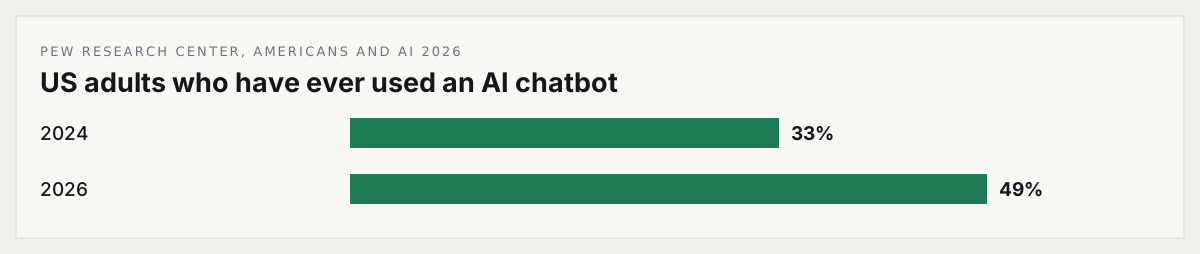
- 49% of US adults have used an AI chatbot, up from 33% two years earlier.[22]Pew Research Center, Americans and AI 2026, June 2026
- 42% of all US adults use a chatbot to search for information. Among people who use chatbots at all, that rises to 86%.[22]Pew Research Center, Americans and AI 2026, June 2026
- 44% report using ChatGPT specifically. Pew notes its question wording changed in 2026, so treat the year-over-year comparison as theirs, not as a growth rate you can extend.[22]Pew Research Center, Americans and AI 2026, June 2026
- About a quarter of Americans use chatbots daily, including 12% several times a day and 4% almost constantly. About half do not use them at all.[22]Pew Research Center, Americans and AI 2026, June 2026
- Roughly half of adults aged 18 to 49 use chatbots to search for information, against 37% of 50–64 and 20% of those 65 and over.[22]Pew Research Center, Americans and AI 2026, June 2026
- 60% of US adults say they read the AI summaries at the top of search results; 30% say they do not.[22]Pew Research Center, Americans and AI 2026, June 2026
- In a separate survey with different wording, 65% said they at least sometimes come across AI summaries, including 45% who see them often. These two figures are different questions from different waves and are not a trend.[23]Pew Research Center, Americans have mixed feelings about AI summaries in search results, October 2025
- Only 20% find the information in AI summaries extremely or very useful; 28% find it not too or not at all useful.[23]Pew Research Center, Americans have mixed feelings about AI summaries in search results, October 2025
- 53% have at least some trust in AI summaries, but only 6% trust them a lot.[23]Pew Research Center, Americans have mixed feelings about AI summaries in search results, October 2025
- OpenAI reports 700 million weekly users sending 18 billion messages per week as of July 2025, around 10% of the world's adult population.[24]OpenAI, How people use ChatGPT, September 2025
- The share of ChatGPT usage classified as "Seeking Information" grew from 14% to 24% in twelve months, while writing fell from 36% to 24%.[24]OpenAI, How people use ChatGPT, September 2025
- Non-work usage rose from 53% to 73% of all messages over the same period — this is mostly people, not businesses.[24]OpenAI, How people use ChatGPT, September 2025
- Google states that AI Overviews has over 2.5 billion monthly active users and AI Mode has surpassed one billion. Google publishes no definition of a monthly active user for either figure.[25]Google, New controls for website owners in AI search, June 2026
- Against that, independent panel data found fewer than 0.1% of searchers actually click through to AI Mode, while roughly 16% of results pages showed an AI Overview.[3]SparkToro and Datos, Search Happens Everywhere, March 2026
- Google's own position is that "total organic click volume from Google Search to websites has been relatively stable year-over-year." Google publishes no figures, time window or definition of a quality click to support it.[26]Google, AI in Search is driving more queries and higher quality clicks, August 2025
What this means if you run a small business. Assistants are now a real way people look things up, and the information-seeking share of that usage is climbing fast. What nobody neutral has measured is how often those questions are about a local business specifically, so treat the size of this channel as genuinely unknown and the direction as obvious. The work that makes you quotable by an assistant is the same work that makes you findable in search: state what you do, where you do it, and keep it consistent everywhere.
How we chose these numbers
Every figure was read off the producer's own page and checked against the sentence it came from. We excluded three categories on purpose.
SEO vendors, including the good ones. Several of the most-cited statistics in this field come from companies that sell SEO software or services. Some of that research is genuinely well run. We still left it out, because we sell SEO as well and citing a competitor's marketing as evidence for our own is not an argument, it is a circle.
Aggregator roundups. If a number could not be traced to the organisation that produced it, it did not go on the page.
Claims with no method. Several figures we wanted were published without a sample, a window or a definition. Those were dropped rather than hedged.
Some gaps are therefore permanent. No neutral organisation publishes what share of small business owners do their own marketing, how many pages get no search traffic, or how often people ask an assistant for a local business recommendation. Those claims are absent here because the evidence is absent, not because they are unimportant.
What the October primary files add
These figures were read off the SBA Advocacy FAQ already in the source list, and off Stanford HAI's April 2026 takeaways. They are not local-discovery rates, and they are not vendor surveys.
- Federal paperwork collections cost small businesses over $81 billion in 2025.[4]SBA Office of Advocacy, Frequently Asked Questions About Small Business, February 2026
- From January 1995 to December 2024, small businesses created 20.7 million net new jobs under SBA Advocacy's dynamic sizing of Business Employment Dynamics.[4]SBA Office of Advocacy, Frequently Asked Questions About Small Business, February 2026
- Those small-business gains were 61 percent of net new job creation over that window.[4]SBA Office of Advocacy, Frequently Asked Questions About Small Business, February 2026
- U.S. generative AI population adoption was 28.3%, 24th globally.[27]Stanford HAI, Inside the AI Index: 12 Takeaways from the 2026 Report, April 2026
- 33% of Americans expect AI to make their jobs better, against a global average of 40%.[27]Stanford HAI, Inside the AI Index: 12 Takeaways from the 2026 Report, April 2026
Article Sources
- United States v. Google LLC, Memorandum Opinion (Findings of Fact), No. 1:20-cv-03010-APM, D.D.C., August 5 2024↩
- United States v. Google LLC, Remedies Memorandum Opinion, No. 1:20-cv-03010-APM, D.D.C., September 2 2025↩
- SparkToro and Datos, Search Happens Everywhere, March 2026↩
- SBA Office of Advocacy, Frequently Asked Questions About Small Business, February 2026↩
- US Census Bureau, Statistics of U.S. Businesses, 2022 annual data↩
- US Census Bureau, Business Owner Characteristics release, November 2025↩
- US Census Bureau, Business Formation Statistics, September 2026 release↩
- US Census Bureau, Business Formation Statistics monthly time series↩
- US Bureau of Labor Statistics, Business Employment Dynamics, survival of private sector establishments↩
- US Bureau of Labor Statistics, Business Employment Dynamics news release, fourth quarter 2025↩
- US Bureau of Labor Statistics, Employment Situation, Table A-9, August 2026↩
- Chrome UX Report methodology, Google Chrome developer documentation↩
- HTTP Archive, Web Almanac 2025, SEO chapter↩
- HTTP Archive, Web Almanac 2025, Accessibility chapter↩
- HTTP Archive, Web Almanac 2025, Performance chapter↩
- HTTP Archive, Web Almanac 2025, CMS chapter↩
- Google Search Central, In-depth guide to how Google Search works↩
- Google Search Central, Control your snippets in search results↩
- Google Search Central, Influencing your title links in search results↩
- SparkToro and Similarweb, In 2026, less than one third of Google searches still send a click, June 2026↩
- Pew Research Center, Google users are less likely to click on links when an AI summary appears in the results, July 2025↩
- Pew Research Center, Americans and AI 2026, June 2026↩
- Pew Research Center, Americans have mixed feelings about AI summaries in search results, October 2025↩
- OpenAI, How people use ChatGPT, September 2025↩
- Google, New controls for website owners in AI search, June 2026↩
- Google, AI in Search is driving more queries and higher quality clicks, August 2025↩
- Stanford HAI, Inside the AI Index: 12 Takeaways from the 2026 Report, April 2026↩
Written by Jon Mahler · Reviewed by Jon Mahler
The words behind the numbers are in the glossary. What we actually do with them is monthly SEO.
Want someone to just handle this?
Book a call and Jon will tell you what is actually holding your search visibility back, and what it would take to fix it.
Talk to JonBook a call. No pitch, just a look at your business.